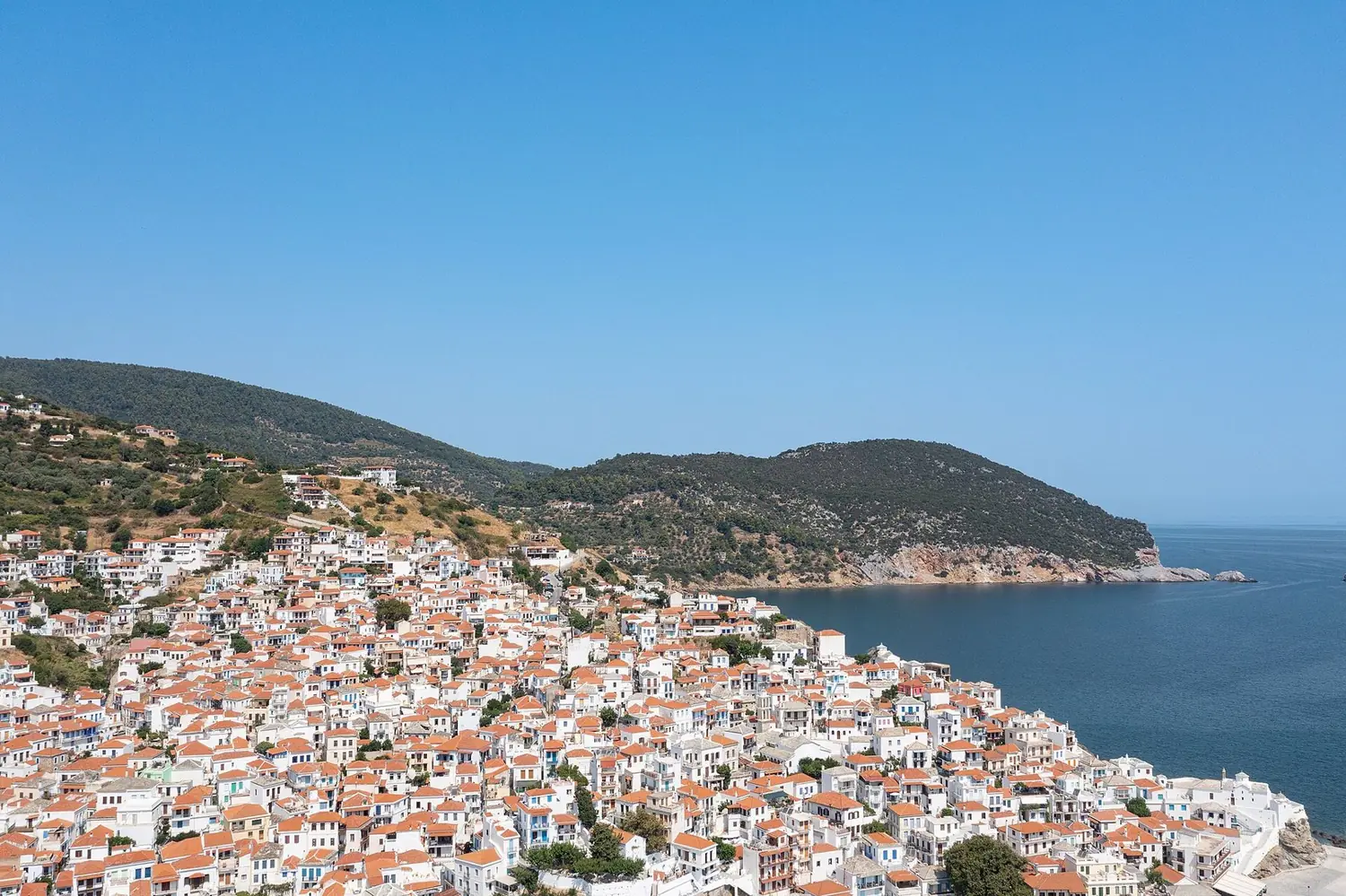
The Kastro of Skopelos
An acropolis, a tower, a square
At the highest point of the Chora, where the steps run out and the view opens over the harbour, stand the walls of the Kastro. They were raised on the acropolis of ancient Peparethos, repaired by Venetians, besieged by Byzantines and sacked by Ottomans. Today they are lit every evening, and the small stone-paved square at their feet fills with tables and music. This is the story of the place.
The acropolis of Peparethos
The present-day town of Skopelos is built on top of the ancient city. In antiquity the island was called Peparethos, and its city spread across the same hill, above the same bay. Legend names Staphylos, a son of Dionysos, as its founder, and its wine was praised from Sophocles to Pliny. Peparethos was a member of the Delian League, struck its own coins and felt the armies of Philip V of Macedon.
Its acropolis stood exactly here, at the top of the Chora. The medieval walls did not start from nothing. They followed the line of the ancient enclosure and reused its foundations. In several places the large, finely cut blocks of the classical period can still be seen beneath the medieval masonry.
A few metres from the walls stands the church of Agios Athanasios. It is considered the oldest surviving church on the island, dated to the eleventh century, and local tradition holds that it was built over an ancient temple of Athena. Its interior is decorated with frescoes from the seventeenth century. It is the quietest witness to the continuity of this place: worship upon worship, stone upon stone.
The Byzantine wall and the Ghisi
Through the Byzantine centuries the fortification of the Chora followed the same ancient line. It was a walled village more than a castle, enough to shelter its people from the pirate raids that plagued the Aegean.
In 1204 the Fourth Crusade took Constantinople and the Byzantine Empire fell apart. The islands of the Aegean were shared out among Venetian adventurers. In 1207 the Venetian Jeremiah Ghisi (Geremia Ghisi) seized Skopelos, Skiathos and Skyros and became their lord, while his brother Andrea took Tinos and Mykonos.
Under the Ghisi the castle was repaired and took its final form. It was not large. In essence it was a massive tower on the ancient acropolis, controlling the bay and the mouth of the harbour. Its real defence was the town itself: a maze of narrow, steep lanes, interrupted by low arches, that made every approach slow and exposed. In 1260 Skopelos appears in an official list of fortresses as a Venetian stronghold.
Licario and the summer without water
Michael VIII Palaiologos, who retook Constantinople in 1261, wanted the islands back. He was served by a Lombard knight from Euboea, Licario, who had changed sides and risen to admiral of the emperor. Around 1277, with a Byzantine fleet, he turned on the Northern Sporades.
The castle of Skopelos was thought impregnable. Licario, however, knew its weakness: it had no water supply of its own. He besieged it in the heart of summer and waited. After a long siege the garrison surrendered for thirst. Filippo Ghisi, lord of the island, was sent in chains to Constantinople. Skiathos, Skyros and Amorgos fell soon after.
Venice did not give up at once. In 1299 a Venetian fleet briefly recovered the island. The treaty of 1302, though, returned most of the islands to Byzantium, the Cyclades excepted. Skopelos remained Byzantine for almost a century.
Between two empires
The fourteenth century belonged to the pirates. Around 1390, during the Ottoman raids in the Aegean under Bayezid I, the island fell to the Turks for the first time. The occupation did not last. The Treaty of Gallipoli of 1403, after Bayezid was defeated by Timur, returned Skopelos to the Byzantines.
In 1453 Constantinople fell and Byzantium was extinguished. The people of Skopelos had to choose. Around 1454 they asked for the protection of Venice and handed the island to the Serenissima. For some eighty years Scopelo, as the Venetians called it, was a small outpost of the Republic in the northern Aegean.
In 1538 Hayreddin Barbarossa, admiral of the Ottoman fleet, seized and sacked the island. It was one of the darkest summers in the history of Skopelos. In 1540, at the end of the third Venetian-Ottoman war, the Northern Sporades passed formally to the Ottoman Empire. The castle had by then lost its military meaning.
The Ottoman centuries and the town of churches
The Ottoman period on Skopelos had a character of its own. No permanent Turkish population ever settled on the island. The islanders paid their taxes, kept their own local government and enjoyed privileges that other places never knew. Their wine, their oil and their ships brought prosperity.
That relative freedom is visible in the stones. After 1538 came a boom in church building. The Chora alone counts more than one hundred and twenty churches and chapels, most of them private, often opened only on the feast day of their saint. The whole island exceeds three hundred and sixty. Bell towers and domes mark every turn of the way up to the Kastro.
The Venetians left, but they left traces. Surnames of Skopelos families, place names and words of the local dialect still carry Italian roots. The name Kastro itself is a word that travelled. On 3 February 1830, under the London Protocol, Skopelos became part of the newly founded Greek state.
The architecture of the Chora
Skopelos Town has been listed since 1978 as a traditional settlement of outstanding beauty, and with reason. Its houses are two storeys high, whitewashed, with four-pitched roofs of grey slate that shine after rain. Such roofs are unusual on an Aegean island and recall Pelion and Macedonia more than the Cyclades.
The Macedonian influence is no accident. Builders and merchants from northern Greece brought their own tradition: wooden balconies and projecting upper rooms, shutters painted deep blue, green and terracotta, wooden doors with carved lintels. Courtyards fill with bougainvillea and jasmine that spill over the walls into the lanes.
The higher one climbs towards the Kastro, the tighter the town becomes. The steps grow steeper, the lanes narrower, the arches lower. It is the same defensive maze the medieval sources described, except that today it leads not to a garrison but to a view.
Mylos Square beneath the walls
The way from the harbour climbs through the lanes of the old town: steps, arches, small churches, courtyard doors. At the edge of the town the lanes give way to Mylos Square, a stone-paved square directly beneath the walls of the Kastro.
From the square the eye takes in the bay and the open Aegean. In the evening the sky over the water turns peach and copper, the lights of the town come on one by one and, behind the square, the stone wall of the Kastro is softly lit.
Evening music at the Kastro is a long habit of the town: the tavernas around the walls have live music through the summer, and people climb up after sunset to hear it. When the tables fill and the first songs begin, the square becomes once more a place where the town gathers above the sea.
Castello under the walls
Castello sits on Mylos Square, with the lit wall of the Kastro behind it and the bay in front. White chairs, blue-and-white checked tablecloths, string lights stretched above the stones. It opened in 2023 and is run by the family that has also run the Vrachos cocktail bar, one hundred and eight steps above the port, since 2016.
Every evening of the season a trio of musicians, on guitar, bouzouki and double bass, plays traditional Greek songs beneath the walls. It is not a show. It is the continuation of a local habit. Whoever climbs the steps this far will find a table, a plate of traditional cooking and a view that has made this corner matter for two and a half thousand years.
The Kastro of Skopelos
Timeline
- 5th c. BC
The acropolis of Peparethos
The ancient city of Peparethos, on the site of the present Chora, fortifies its acropolis. The foundations of its wall will be reused by Byzantines and Venetians.
- 11th c.
Agios Athanasios
The church of Agios Athanasios is built beside the Kastro, the oldest surviving church on the island, by tradition over an ancient temple of Athena.
- 1204
The Fourth Crusade
The Crusaders take Constantinople. The islands of the Aegean pass into the sphere of Venice.
- 1207
Jeremiah Ghisi
The Venetian Jeremiah Ghisi seizes Skopelos, Skiathos and Skyros. The castle is repaired and takes the form of a large tower on the acropolis.
- 1260
A Venetian fortress
Skopelos is recorded in an official list of fortresses as a Venetian stronghold.
- c. 1277
The siege of Licario
The Lombard knight Licario, in the service of Michael VIII Palaiologos, takes the castle after a long siege. The garrison surrenders for lack of water. Filippo Ghisi is sent in chains to Constantinople.
- 1299–1302
Venetian counter-attack and treaty
A Venetian fleet briefly recovers the island. The treaty of 1302 returns it to Byzantium.
- c. 1390
Ottoman raid
During the Aegean raids of Bayezid I the island falls to the Turks for the first time.
- 1403
The Treaty of Gallipoli
Skopelos is returned to the Byzantines.
- 1453–1454
Under the protection of Venice
After the fall of Constantinople the islanders choose Venetian protection. The island becomes Scopelo of the Serenissima.
- 1538–1540
Barbarossa
Hayreddin Barbarossa seizes and sacks the island. In 1540 Skopelos passes formally to the Ottoman Empire. The great age of church building follows.
- 1830
The Greek state
Under the London Protocol Skopelos becomes part of the newly founded Greek state.